
High monthly premiums for medical coverage can stretch a fixed retirement budget thin. Many seniors seek a middle ground between full-coverage plans and Medicare Advantage. Medicare Supplement Plan K and Plan L offer exactly that balance. These options keep your monthly costs low by sharing medical bills until you hit a set yearly limit.
Medicare Supplement Plan K and Plan L are standardized Medigap policies that lower your premiums through cost-sharing structures. Plan K covers 50% of most Medicare-approved costs, with a yearly out-of-pocket limit of $8,000 in 2026. Plan L pays 75% of those same costs, with a lower out-of-pocket limit of $4,000. These plans provide key safety nets under Medicare.gov guidelines. After you hit your yearly limit and pay the Part B deductible, the plan pays 100% of covered services for the rest of the year. This makes them a strong fit if you want lower monthly premiums but still need protection from major medical bills.
Compare Medicare Supplement Plan K and Plan L pricing now and see how much you could save on your monthly premiums.
Choosing between these two cost-sharing options depends on your budget and how often you visit the doctor. Finding the right balance requires a close look at how each plan structures its benefits. To help you compare, let us start with a simple overview of what is included in our first section, What Are Medicare Supplement Plans K and L?
Medicare Supplement Plan K and Plan L: What Are Medicare Supplement Plans K and L?
Most Medigap policies pay for all or nearly all of your out-of-pocket healthcare costs. But Medicare Supplement Plan K and Plan L use a different approach. These plans are designed for people who want to buy coverage with lower monthly premiums. In exchange, you agree to take on a larger share of your own healthcare costs through a cost-sharing structure.
A Standardized Framework for Lower Costs
Like all Medigap options, Plans K and L are standardized by the federal government. This standardization means the core benefits for each plan letter must be identical. A plan’s benefits are the same regardless of which private insurance company you buy it from. You can read more about these rules on Medicare.gov. The main difference with Plans K and L is that they pay a percentage of your bills instead of the full amount. Plan K pays fifty percent of your covered costs, while Plan L pays seventy-five percent.
How the Cost-Sharing Model Works
The cost-sharing model helps you save money on monthly premiums. Under this system, you pay your share of the costs until you hit a yearly out-of-pocket cap. According to Medicare.gov, once you meet this limit and pay your yearly Part B deductible, the plan pays one hundred percent of your covered services. This cap protects you from high medical bills if you have a major health issue. These plans are one of the few options that offer this kind of safety net.
What These Plans Do Not Cover
There are some costs that Plans K and L do not pay. Neither plan covers the Medicare Part B deductible, which is a common rule for newer Medigap policies. You must pay this deductible yourself before the plan pays its share of your Part B services. Also, neither plan pays for Part B excess charges. Excess charges can happen if a doctor does not accept the standard Medicare payment rate. Finally, these options do not cover emergency care if you travel outside of the country.
Medicare Supplement Plan K: Coverage and Cost-Sharing
Medicare Supplement Plan K offers a unique path to manage your healthcare expenses. Unlike traditional options that cover your costs from day one, Plan K uses a cost-sharing framework. This design lets you pay lower monthly premiums in exchange for taking on more shared costs when you receive care. It provides a balanced choice if you want to protect your savings without paying for first-dollar coverage you may not need.
How the Fifty Percent Cost-Sharing Works
The core feature of this option is its fifty percent coverage rate. Plan K pays half of your out-of-pocket costs for most services covered by Medicare. For example, the plan covers half of the Medicare Part A hospital deductible, which helps lower your costs during an inpatient hospital stay. To learn how this fits into your overall coverage, you can read our cost-sharing Plan K and Plan L guide.
This half-share coverage also applies to several other key services. The plan pays fifty percent of your Medicare Part B coinsurance or copayments when you visit a doctor. It also covers half of the cost for your first three pints of blood, Part A skilled nursing facility care coinsurance, and Part A hospice care coinsurance. You can review these specific benefit details on the official Medicare benefit comparison page.
Services Covered at One Hundred Percent
While Plan K relies on cost-sharing for most services, some benefits are covered fully from the start. First, Plan K pays one hundred percent of your Medicare Part A hospital coinsurance and hospital costs. This full protection lasts for up to an additional 365 days after your original Medicare benefits are completely used. This safeguard ensures a major hospital stay will not lead to severe financial hardship.
Second, Plan K covers preventive care services at one hundred percent. When you get Medicare-approved wellness checks, screenings, or vaccines, you do not pay any coinsurance or copayments. Under Plan K, these preventive services bypass the usual cost-sharing rules entirely to help you maintain your health. You can find more detail on these preventive benefits through Humana’s Plan K and L overview.
The Annual Out-of-Pocket Safety Net
To protect you from high medical bills, Plan K includes a built-in safety net known as an out-of-pocket limit. For 2026, the Plan K annual out-of-pocket limit is $8,000, which is an increase from the 2025 limit of $7,220. Once your shared costs reach this yearly cap and you pay your annual Part B deductible, the plan pays one hundred percent of your Medicare-covered services for the rest of the calendar year. This cap gives you peace of mind by setting a strict limit on your annual medical spending.
Medicare Supplement Plan L: Coverage and Cost-Sharing
Medicare Supplement Plan L is a strong option for people who want to lower their monthly insurance bills. Like other Medigap plans, it has standard benefits. But Plan L works by sharing costs with you. This plan pays a set percentage of your healthcare costs, and you pay the rest until you reach a yearly limit. It is an excellent fit for those who want a safety net without paying high monthly rates.
Check Plan L rates and availability in your area to see if this cost-sharing model works for your budget.
How Plan L Shares Covered Costs
Plan L covers most Medicare benefits at seventy-five percent. This means you must pay twenty-five percent of these costs yourself. Plan L pays seventy-five percent of the Medicare Part A hospital deductible, skilled nursing facility coinsurance, and Part A hospice care coinsurance. It also pays seventy-five percent of the first three pints of blood and seventy-five percent of your Part B coinsurance or copayments. You can read more about Medigap rules on Medicare.gov to see how these costs add up.
Some benefits do not use this cost sharing rule. For example, Plan L covers preventive care services at one hundred percent, so you pay nothing for them. But Plan L does not pay your yearly Part B deductible, which is two hundred eighty-three dollars in 2026. It also does not cover Part B excess charges or foreign travel emergencies. If you want to see if this model fits your needs, you can review Plan K and Plan L options online.
Understanding the Annual Out of Pocket Limit
The best part of Plan L is its yearly out of pocket limit. This limit is also called the maximum out of pocket limit, or MOOP. For 2026, the Plan L limit is four thousand dollars, which is up from three thousand six hundred ten dollars in 2025. This cap protects you from very high medical bills if you face a serious health issue during the year.
Once your out of pocket costs and the Part B deductible reach this limit, the plan changes. Plan L will then pay one hundred percent of your covered costs for the rest of that calendar year. This cap makes Plan L much safer than original Medicare alone, which has no limit on what you might have to pay.
Who is Plan L Best For?
Plan L works best for people who do not go to the doctor very often. If you are in good health, you can save money on your monthly premiums. You trade a lower monthly bill for the risk of paying small fees when you get medical care. Since the yearly limit is low, you still have great protection if you get very sick. It helps you keep your healthcare costs steady and predictable throughout the year.
Plan K vs Plan L: Side-by-Side Comparison
When you compare Medicare Supplement Plan K and Plan L, the main difference lies in how they split your healthcare costs. Both plans help protect you from high medical bills by using a cost-sharing structure. But Plan L offers higher coverage levels in exchange for a slightly higher monthly premium. Plan K covers 50% of most medical costs, while Plan L covers 75% of those same costs.
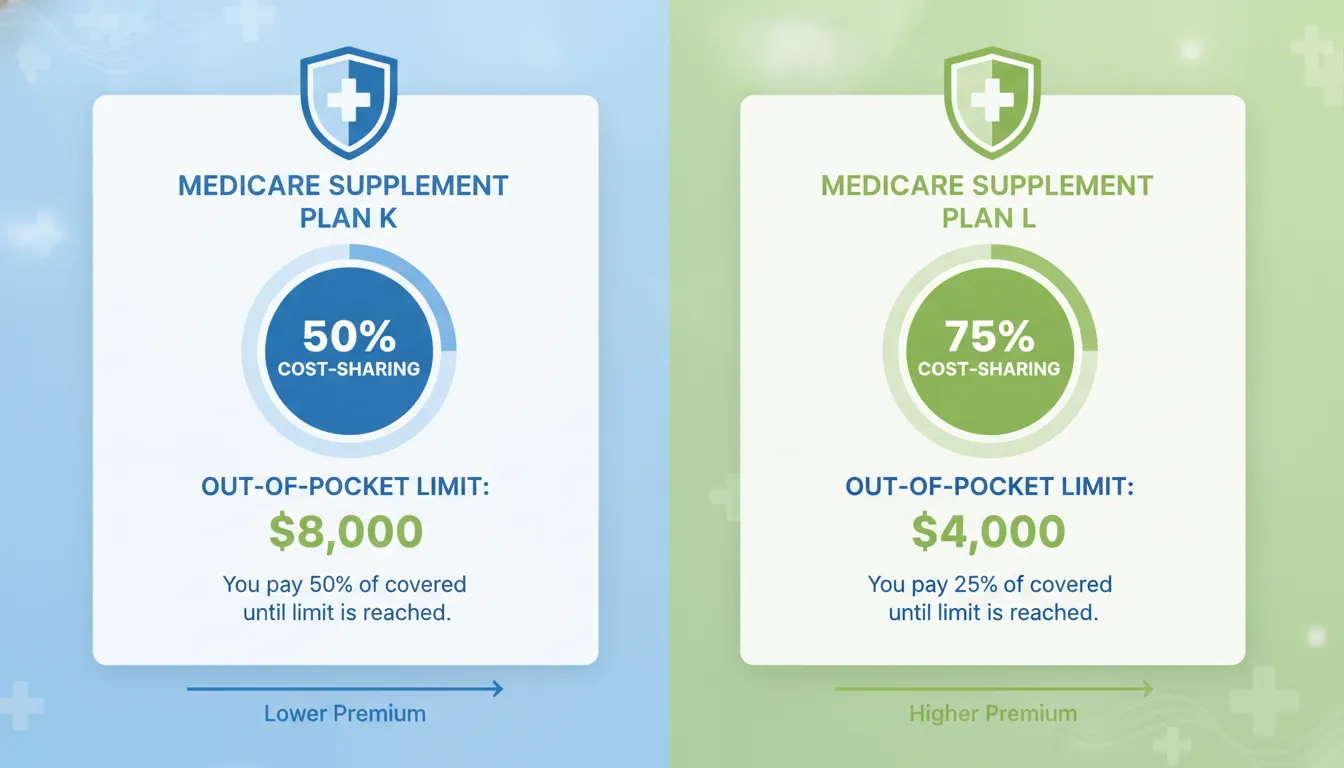
The table below compares these two cost-sharing Medigap plans in detail. By reviewing these details, you can see how each plan handles key Medicare benefits, deductibles, and out-of-pocket limits.
| Medigap Benefit | Plan K Coverage | Plan L Coverage |
|---|---|---|
| Basic Coverage Level | Pays 50% of covered services | Pays 75% of covered services |
| Annual Out-of-Pocket Limit (2026) | $8,000 | $4,000 |
| Part A Hospital Coinsurance | 100% (plus 365 extra days) | 100% (plus 365 extra days) |
| Part A Deductible | Pays 50% | Pays 75% |
| Skilled Nursing Facility Coinsurance | Pays 50% | Pays 75% |
| Hospice Care Coinsurance | Pays 50% | Pays 75% |
| First 3 Pints of Blood | Pays 50% | Pays 75% |
| Part B Deductible Coverage | No coverage (neither plan covers) | No coverage (neither plan covers) |
| Part B Excess Charges | No coverage (neither plan covers) | No coverage (neither plan covers) |
| Foreign Travel Emergencies | No coverage (neither plan covers) | No coverage (neither plan covers) |
| Best For Beneficiaries Who | Want the lowest monthly premium | Want a lower yearly out-of-pocket cap |
Understanding the Premium and Out-of-Pocket Tradeoff
As you evaluate cost-sharing Plan K and Plan L options, the premium tradeoff is the most important factor to consider. Insurance companies usually charge higher monthly premiums for Plan L than they do for Plan K. However, Plan L cuts your financial risk in half with a lower yearly out-of-pocket ceiling. If you choose Plan K, you pay a lower premium but must take on a larger portion of your medical bills.
For 2026, the official out-of-pocket limit for Plan K is $8,000, while the limit for Plan L is $4,000. These limits are set by the federal government and are tracked by Medicare.gov each year. If your medical bills are high, Plan L might save you money overall. But if you rarely go to the doctor, the premium savings from Plan K may make it the better choice for your budget.
How the Annual Out-of-Pocket Limit Works
The annual limit acts as a critical safety net. Once your total out-of-pocket costs for Medicare-approved services reach the plan limit, your Medigap policy shifts to cover 100% of your remaining medical bills. To trigger this benefit, you must also pay your yearly Medicare Part B deductible. According to federal guidelines, this Part B deductible is $283 for the 2026 calendar year.
Once you meet both the plan limit and the Part B deductible, your plan pays all covered costs. This includes Part A coinsurance, skilled nursing facility copays, and standard Part B costs. This high-level coverage remains in place for the rest of that calendar year. This feature is why many premium-sensitive buyers choose Plan K and Plan L options as a way to secure catastrophic protection without paying high monthly rates.
How Plans K and L Compare to Plans G and N
When you look for supplemental coverage, you will likely hear about Plan G and Plan N. Most brokers talk about these options because they cover almost all your out-of-pocket gaps. But choosing the right coverage means looking at both your budget and your health needs. By looking at how these popular options compare to Medicare Supplement Plan K and Plan L, you can find the best match for your wallet.
The Coverage Gap Between the Plans
Medicare Supplement Plan G is the gold standard for many people because it is highly complete. Once you pay your annual Part B deductible, Plan G pays 100% of your remaining covered medical costs. It also covers Part B excess charges, which are extra fees some doctors can charge if they do not accept Medicare payment rates as full payment. You can learn more about how these structures work by checking the official Medicare plan comparison guide.
Plan N also offers strong coverage but introduces small copays to help lower your premium. Under Plan N, you pay up to $20 for some office visits and up to $50 for emergency room visits. Unlike Plan G, Plan N does not cover Part B excess charges. Still, both G and N pay 100% of the key out-of-pocket gaps from day one, unlike the cost-sharing models of Plans K and L.
The Premium and Out-of-Pocket Trade-Off
Choosing between these options comes down to how you want to pay for your healthcare. Plans G and N have higher monthly premiums, but they give you peace of mind with very low out-of-pocket costs when you go to the doctor. They are ideal if you want predictable costs and use medical services often.
In contrast, Plans K and L have much lower monthly premiums. In exchange for those savings, you agree to share the cost of your care until you hit your annual limit. This makes them a solid choice if you want to save money on premiums and do not go to the doctor frequently. If you are debating between these two approaches, it helps to read about cost-sharing Medigap plans to see which financial style fits your lifestyle.
Finding Your Best Fit
If you prefer to pay a set fee each month and have Medicare cover almost everything else, Plan G or Plan N is likely your best path. But if you are healthy, want to save on premiums, and feel comfortable paying a portion of your bills, Plan K or Plan L could be a smart move. They protect you from high costs with their yearly limits while keeping your fixed monthly bills low.
Who Should Consider Medicare Supplement Plans K and L?
Deciding on a Medigap policy means looking at your health needs and your wallet. For many people, Medicare Supplement Plan K and Plan L offer a smart way to get coverage. These options are best if you want to pay lower monthly rates but do not mind paying a portion of your care when you see a doctor. They provide a balanced path between low monthly costs and protection from large medical bills.
People with Low Healthcare Use
If you only visit the doctor once or twice a year, you are an ideal match for these options. Paying a high premium every month for a plan like Plan G does not make sense if you rarely use medical services. With Plan K or Plan L, your monthly bill is low. You only pay your share of the cost when you actually get care, which keeps your overall costs down.
For example, if you have two routine checkups a year, your out-of-pocket costs will be small. You will pay your Part B deductible and a small copay for each visit, but you save hundreds of dollars in premiums over the year. In contrast, someone with a chronic illness who visits the doctor every month would face frequent copays. For those individuals, the steady cost-sharing would quickly add up, making a full-coverage plan a better deal.
Those Who Want a Safety Shield
Some people want to avoid big, unexpected medical bills but still want to save money on premiums. Medicare Supplement Plan K and Plan L provide an excellent safety net through their out-of-pocket limits. For 2026, the out-of-pocket limit is $8,000 for Plan K and $4,000 for Plan L, according to Medicare.gov. Once you reach this limit and pay your Part B deductible, the plan pays 100% of your covered medical costs for the rest of the year.
This cap protects you from catastrophic costs if you have a major health event, like a long hospital stay. It gives younger or healthier beneficiaries peace of mind. You get the low monthly rates of a partial-coverage plan, but you never have to worry about unlimited medical bills if your health changes suddenly.
Buyers Seeking the Best Value
If you are comfortable managing your own budget, Medicare Supplement Plan K and Plan L let you balance your monthly costs against your actual medical needs. They are great for people who want some protection but have a tight monthly budget. By choosing these Plan K and Plan L options, you take on some cost-sharing in exchange for keeping more money in your bank account each month. It is a simple trade that works well if you want to stay in control of your health spending.
Frequently Asked Questions
What is the difference between Medicare Plan K and L?
The main difference is how much they pay and their out-of-pocket limits. Plan K covers 50% of most medical costs and has a $8,000 out-of-pocket limit in 2026. Plan L covers 75% of those costs and has a lower $4,000 limit in 2026. You can compare these options on the Medicare benefits page. Plan L has higher premiums than Plan K.
What is Medicare Supplement Plan L?
Medicare Supplement Plan L is a cost-sharing Medigap plan that helps pay your share of Medicare costs. According to Medicare.gov, Plan L pays 75% of your Part A deductible, skilled nursing care, and Part B coinsurance. Once your out-of-pocket costs hit $4,000 in 2026, the plan pays 100% of covered services for the rest of the year.
How do Medicare Supplement Plans K and L work?
These plans require you to share medical costs until you hit a yearly out-of-pocket cap. You pay a percentage of your bills, and the plan pays the rest. Once you meet the Part B deductible and your yearly out-of-pocket limit, your plan pays 100% of covered costs. This structure protects you from high hospital bills while keeping your monthly premiums low.
Do Medicare Supplement Plans K and L cover the Part B deductible?
No, neither Plan K nor Plan L covers the Medicare Part B deductible, which is $283 in 2026. You must pay this entire amount yourself before your plan begins to cover its share of Part B outpatient services. They also do not cover Part B excess charges if a doctor bills more than the Medicare-approved amount.
We do not offer every plan available in your area. Currently, we represent 10 organizations that offer 50 products in your area. Please contact Medicare.gov or 1-800-MEDICARE to get information on all of your options.
Ready to Compare Your Medigap Options?
Choosing the wrong Medicare coverage can result in high out-of-pocket costs and unexpected medical bills. Since your health needs can change quickly, delaying this decision may leave you without the financial protection you need when a sudden medical issue arises. Finding the right balance between low monthly premiums and reliable coverage helps secure your retirement savings. Work with a licensed expert to review your choices before your next enrollment period ends today.
You do not have to navigate these complex choices alone. Ready to find the right plan? Please schedule a free Medicare plan comparison consultation to explore all of your options with a trusted independent broker at no extra cost to you. Browse all Medigap plans we offer to compare rates side by side.
Not Sure Which Medicare Plan Is Right for You?
Medicare is complicated, but you do not have to figure it out alone. With over 20 years of experience, Karl Bruns-Kyler can help you compare plans, avoid costly mistakes, and find the coverage that fits your needs and budget.
Call (877) 850-0211
Or schedule a free consultation at a time that works for you.
There is never a charge for my services. Your premium is the same whether you work with me or go direct.
Disclaimer: We do not offer every plan available in your area. Currently, we represent 10 organizations that offer 50 products in your area. Please contact Medicare.gov or 1-800-MEDICARE to get information on all of your options.