

Prescription drug coverage can feel like the most confusing part of Medicare. Understanding how Medicare Part D works helps you compare plans based on the medications you actually take, avoid preventable enrollment penalties, and prepare for what you may pay at the pharmacy. Part D is private insurance approved by Medicare that helps cover outpatient prescription drugs.
Need help comparing your medications with available Medicare plans? Talk with Karl Bruns-Kyler at The Big 65 for a no-cost, one-on-one coverage review at 877-850-0211.
Part D is not one standard plan. Each insurer sets its own premium, deductible, pharmacy network, formulary, and cost-sharing rules. That is why the lowest monthly premium is not always the lowest total annual cost for you. This guide explains the mechanics so you know what to review before you enroll or make an annual change.
What Is Medicare Part D and Who Needs It?
Medicare Part D is optional prescription drug coverage for people with Medicare. You can get it through a standalone Prescription Drug Plan alongside Original Medicare, or through a Medicare Advantage plan that includes drug coverage. If you have creditable drug coverage from another source, you may not need to enroll immediately, but you should keep proof of that coverage.
There are two common paths:
- Original Medicare plus Part D: You can pair a standalone drug plan with Original Medicare. Many people in this path also consider a Medicare Supplement (Medigap) plan, which does not include outpatient prescription drug coverage.
- Medicare Advantage with drug coverage: Many Medicare Advantage plans package Part A, Part B, and Part D coverage together. Check the plan’s formulary and pharmacy network before choosing it.
For a broader explanation of how the pieces fit together, review the four parts of Medicare. The key point is simple: Part D covers retail and mail-order prescription drugs, while Original Medicare generally does not.
How Medicare Part D Works Through the Year
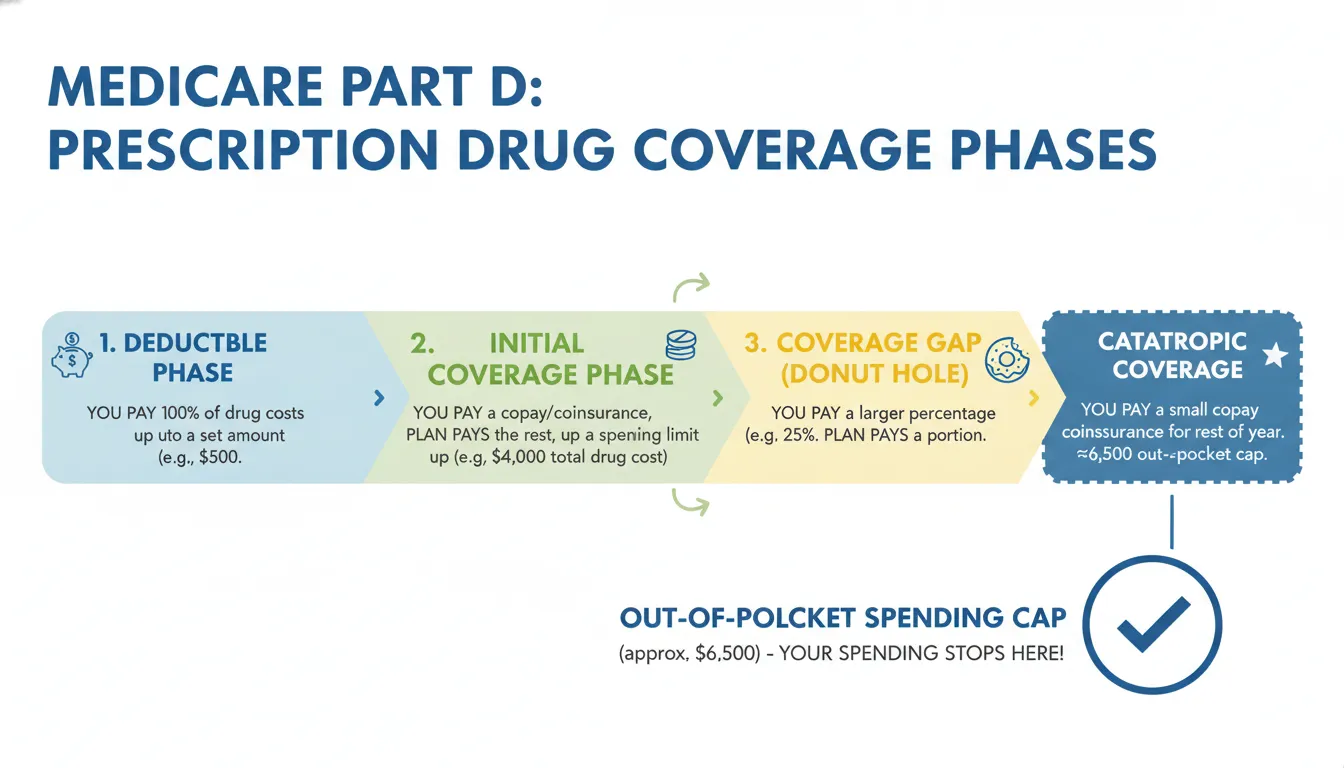
In 2026, a standard Part D benefit generally moves through a deductible phase, an initial coverage phase, and catastrophic coverage. Your actual cost depends on the plan you choose and the drugs you fill, but covered out-of-pocket spending is capped at $2,100 for the year. Plan premiums do not count toward that cap.
The deductible phase
Some plans require you to pay the full negotiated cost of drugs until you meet the deductible. For 2026, the maximum standard deductible is $615, though individual plans may use a lower deductible or waive it for selected drug tiers. A deductible is not the same as your monthly premium.
The initial coverage phase
After the deductible, you usually pay a copayment or coinsurance for covered medications while the plan pays the rest. The amount can vary sharply by tier, pharmacy, and whether a drug is preferred. This is where comparing your personal medication list matters more than comparing a plan’s advertised premium.
Catastrophic coverage and the annual cap
Once your out-of-pocket spending on covered Part D drugs reaches the annual limit, you enter catastrophic coverage and pay $0 for covered Part D prescriptions for the rest of the calendar year. The old coverage-gap structure, often called the donut hole, no longer works as a separate phase in the redesigned Part D benefit.
Midyear question about a costly prescription? Review the Part D coverage options The Big 65 discusses before assuming a higher premium means better drug coverage.
What Is a Part D Formulary?
A formulary is a plan’s covered-drug list. It tells you whether a medication is covered, which tier it occupies, whether prior authorization applies, and whether the plan requires a step therapy or quantity-limit review. A formulary can change from year to year, so a plan that worked well last year may not be the best fit next year.
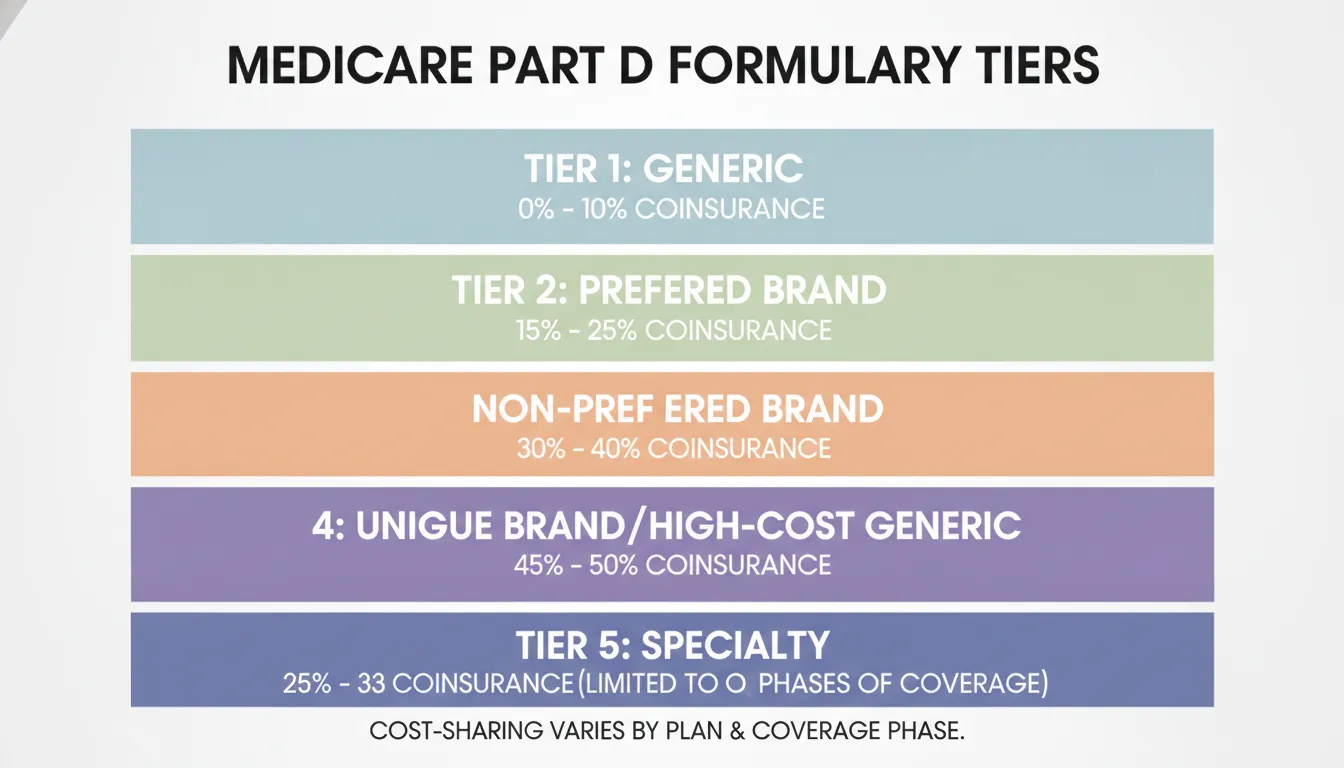
Most plans organize medications into tiers. Lower tiers commonly have lower costs, while specialty drugs often have coinsurance rather than a flat copayment.
Coverage is not always a simple yes-or-no question. A plan may cover a medication only after prior authorization, may ask you to try a lower-cost alternative first, or may limit the amount you receive at one time. If your prescriber believes a plan rule is not appropriate, an exception or coverage determination may be available. Understanding those rules before enrolling can reduce surprises when it is time for a refill.
| Typical tier | What it often includes | What to check |
|---|---|---|
| Tier 1 | Preferred generics | Low copayment or $0 cost at preferred pharmacies |
| Tier 2 | Generics | Copayment and pharmacy network |
| Tier 3 | Preferred brand drugs | Copayment or coinsurance and any restrictions |
| Tier 4 | Non-preferred drugs | Higher coinsurance and possible alternatives |
| Tier 5 | Specialty drugs | Coinsurance, utilization rules, and annual cost exposure |
Before selecting a plan, make a current list of your prescriptions, dosage, and preferred pharmacies. Then compare each drug against the plan’s formulary, not just its drug tier. Medicare’s plan tools and a knowledgeable broker can help you identify restrictions that may affect your refill process.
How Do Pharmacy Networks Affect Part D Costs?
Part D plans negotiate prices with pharmacies, so the same medication can cost different amounts at different locations. A preferred in-network pharmacy may offer a lower copayment than a standard in-network pharmacy, while an out-of-network pharmacy can result in much higher costs or limited coverage.
Check whether your usual pharmacy is in the plan’s preferred network and whether mail-order service makes sense for your maintenance medications. If you travel or split time between states, also ask how the plan handles refills away from home. A plan review should account for access as well as price.
For example, a plan can appear affordable until a prescription is filled at a standard rather than preferred pharmacy. If you use a local independent pharmacy, confirm that it participates before enrolling. A lower cost at a preferred pharmacy only helps if that pharmacy is practical for you to use throughout the year.
When Can You Enroll in or Change Medicare Part D?
Medicare Part D enrollment is tied to specific windows. The right window depends on whether you are new to Medicare, reviewing annual coverage, or experiencing a qualifying life event. Missing the window can delay changes or create a late enrollment penalty.
Initial Enrollment Period
Your Initial Enrollment Period is generally the seven-month period around the month you turn 65. If you are delaying Part B because you still have qualifying employer coverage, your timing may be different. Those coming off work coverage should review Medicare options when retiring or leaving employer coverage before making a decision.
Annual Enrollment Period
From October 15 through December 7, you can join, switch, or drop a Part D plan for coverage beginning January 1. This is the most important time to compare your medications against the coming year’s formularies, premiums, and pharmacies. See the 2026 Medicare costs overview for context on premiums and other Medicare expenses.
Special Enrollment Period
A Special Enrollment Period may be available after certain life events, such as moving outside your plan’s service area, losing creditable drug coverage, or qualifying for Extra Help. Eligibility is situation-specific, so verify the deadline before assuming you can change plans.
How Can You Avoid the Part D Late Enrollment Penalty?
If you go 63 days or more without Part D or other creditable prescription drug coverage after you are eligible, you may owe a late enrollment penalty when you later enroll. Medicare calculates the penalty from the number of full uncovered months, and it is generally added to your Part D premium for as long as you have Part D.
If you have employer, union, VA, or other drug coverage, ask whether it is creditable and save the written notice. Do not cancel coverage or delay enrollment based only on an assumption. The rules can vary with your employment status and the type of coverage you have.
What Is the Medicare Prescription Payment Plan?
The Medicare Prescription Payment Plan lets you spread covered Part D out-of-pocket drug costs into monthly payments rather than paying the full amount at the pharmacy counter. It can help with budgeting, but it does not reduce the amount you owe for covered prescriptions or replace a careful plan comparison.
This option can be especially useful when a high-cost prescription is filled early in the year. Ask your plan how to opt in, how monthly bills are calculated, and what happens if you miss a payment. It is one more tool for managing cash flow, not a substitute for selecting coverage that fits your medications.
How to Compare Part D Plans Before You Enroll
A useful Part D comparison looks at your full annual drug cost, not one feature in isolation. Start with the prescriptions you take today, then consider whether a plan’s rules, pharmacy network, and premium still fit your expected needs next year.
It also helps to separate fixed costs from costs that change with each refill. A plan with a low premium may put an important medication on a higher tier, while a plan with a slightly higher premium may lower your expected cost at the pharmacy. The best comparison looks at the full year, including the deductible, likely copayments or coinsurance, and the pharmacy you expect to use.
- List each medication, dosage, and how often you refill it.
- Check each drug on the plan’s formulary and note its tier and restrictions.
- Compare estimated costs at preferred pharmacies and mail-order options.
- Review the deductible, monthly premium, and annual out-of-pocket exposure.
- Confirm the plan serves your county and supports the way you receive care.
- Recheck every year during Annual Enrollment Period because formularies and costs can change.
Before Annual Enrollment Period, schedule a no-cost medication and plan review with The Big 65. A conversation can help you understand your choices without high-pressure sales tactics.
Frequently Asked Questions About Medicare Part D
Is Medicare Part D required?
No. Part D is optional, but delaying it without other creditable prescription drug coverage can lead to a late enrollment penalty. Review your existing coverage before deciding not to enroll.
Does Medicare Part D cover every prescription drug?
No. Each plan has its own formulary, coverage rules, and tiers. A medication may be covered by one plan but not another, or it may require prior authorization or step therapy.
Does the $2,100 Part D cap include premiums?
No. The annual out-of-pocket cap applies to qualifying costs for covered Part D drugs. Monthly plan premiums do not count toward the cap.
Can I change my Part D plan every year?
Yes. During the Annual Enrollment Period from October 15 through December 7, you can change Part D plans for coverage that begins January 1, subject to Medicare’s rules.
Can I have Medigap and Part D at the same time?
Yes. Medigap helps with certain Original Medicare cost-sharing but does not include outpatient prescription drugs, so people with Medigap commonly enroll in a standalone Part D plan.
Make Medicare Part D Easier to Understand
Medicare Part D works best when the plan is matched to your medications, pharmacy preferences, and budget. A quick annual review can uncover formulary changes, different pharmacy pricing, or a plan that better matches your current needs. The Big 65 can help you compare your options and un-complicate the details.
Call 877-850-0211 or email Gray@TheBig65.com to request a personalized review.
Compliance Disclosure: We do not offer every plan available in your area. Currently, we represent 10 organizations that offer 50 products in your area. Please contact Medicare.gov or 1-800-MEDICARE to get information on all of your options.
Not Sure Which Medicare Plan Is Right for You?
Medicare is complicated, but you do not have to figure it out alone. With over 20 years of experience, Karl Bruns-Kyler can help you compare plans, avoid costly mistakes, and find the coverage that fits your needs and budget.
Call (877) 850-0211
Or schedule a free consultation at a time that works for you.
There is never a charge for my services. Your premium is the same whether you work with me or go direct.
Disclaimer: We do not offer every plan available in your area. Currently, we represent 10 organizations that offer 50 products in your area. Please contact Medicare.gov or 1-800-MEDICARE to get information on all of your options.