
Moving to a new home should not mean losing your healthcare security. While Original Medicare travels with you nationwide, your other plans have strict rules based on your location. You must follow specific timing to keep your coverage active in a new state.
Talk to a licensed Medicare broker today about your move. A broker can review your current plans and your new ZIP code to find the right coverage before you arrive.
When you are moving with Medicare, your new ZIP code determines which private insurance plans are available and how much your monthly premiums will cost you each month. While Original Medicare works in every state, moving outside a plan service area triggers a Special Enrollment Period for most Medicare Advantage and Part D prescription drug plans. According to CMS.gov, you have two months after your move to join a new plan or switch back to Original Medicare to avoid costly gaps in coverage. Medigap plans usually travel with you, but you must still update your address with the Social Security Administration to ensure your healthcare benefits and billing stay active.
Moving is a major life event that needs careful planning for your medical insurance coverage. You must know clearly how your federal benefits travel with you across state lines as you settle into your new home. The best place to begin is with Original Medicare, which follows you wherever you go.
Moving With Medicare: What Happens to Original Medicare When You Move?
Original Medicare Parts A and B are federal programs that work in every state and U.S. territory. You do not need to change or re-enroll when you move. Your hospital and medical coverage continues without interruption as long as you see providers who accept Medicare. The only requirement is updating your address with the Social Security Administration.
Original Medicare is a federal program that stays with you no matter where you live. Since the federal government runs Medicare Parts A and B, your hospital and medical coverage works in all 50 states and U.S. territories. You do not need to apply for a new plan or worry about losing your health benefits when you relocate. Whether you are moving to a new house across town or to a new state across the country, your basic Medicare coverage stays the same.
Care in every state
One of the best parts of Original Medicare is its nationwide reach. You can use your Medicare card with any doctor or hospital in the country that accepts Medicare. There are no plan networks to track or provider directories to check. This makes moving much easier because you do not have to verify whether your new doctor is in a specific network. Your Original Medicare benefits travel with you wherever you go, so your hospital and medical coverage remains uninterrupted from the day you arrive.
Update your address
While your care does not change, you must tell the government where you live. The Social Security Administration handles all address changes for Medicare. You should update your records as soon as you have a new address. This ensures you receive your Medicare bills, plan notices, and important enrollment information on time. You can update your address online through your my Social Security account or by calling 800-772-1213. Keeping your address current helps you stay on track with your coverage deadlines.
Next steps for your move
Moving is a great time to review your full health coverage. Karl Bruns-Kyler has helped people in 33 states find the right Medicare fit. Even if your basic Medicare coverage stays the same, your Medicare Advantage, Part D, or Medigap plan may need changes based on your new ZIP code. This is also the perfect time to explore Medicare Supplement plans that might offer better value in your new state.
What Happens to Your Medicare Advantage Plan When You Move?
Medicare Advantage plans are tied to specific counties or regions. Moving outside your plan service area triggers a Special Enrollment Period that lets you switch to a new plan. Your current coverage will end if your new address falls outside the plan zone. You have at least two months after your move to select a new Advantage plan in your new location.
Unlike Original Medicare, Medicare Advantage plans are tied to specific geographic areas. When you move to a new address, your current Medicare Advantage plan may no longer be available to you. Your plan provider needs your new home address to determine whether you remain within their service area. Understanding how this works before you move can help you avoid gaps in coverage.
How service areas work
Most Medicare Advantage plans have a defined service area, usually limited to a single county or a small cluster of counties. When you move to a new county, you may move outside this area. If your new home is outside the plan service area, your coverage will end. However, if you move within the same county or to a neighboring county still in the plan zone, you may keep your current plan. You should still call your plan provider to confirm that your Medicare Advantage plan continues to cover your new location at the same costs. Your doctor network, copays, and drug coverage may change even if you stay in the same service area.
The special enrollment period for movers
Moving to a new area triggers a Special Enrollment Period (SEP). This is a limited window when you can change your Medicare Advantage or Part D plan without waiting for the annual Open Enrollment Period. This window usually lasts for at least two full months after the month you move, giving you time to find a plan that works in your new location. If you notify your plan before you move, your SEP begins the month before your move and continues for two months after you arrive. If you notify them after you move, the window starts the month you notify them. Acting early gives you the most time to compare options.
Your choices during the SEP
When you move, you have several options for maintaining your healthcare coverage. You are not required to stay with the same type of plan you had before. During your move-related SEP, you can:
- Join a new Medicare Advantage plan available in your new county.
- Switch back to Original Medicare (Parts A and B).
- Sign up for a standalone Part D prescription drug plan.
- Enroll in a Medigap plan if you return to Original Medicare.
You must notify your current plan as soon as you know you are moving. If you move without alerting your plan, you might discover that your doctors are now out of network or that your coverage has been terminated. Contacting your plan early helps you avoid higher out-of-network costs and gaps in your care.
Does Medicare Part D Coverage Transfer to a New State?
Part D prescription drug plans are state-specific and do not cross state lines. Moving to a new state requires you to enroll in a new Part D plan available in your new ZIP code. A Special Enrollment Period gives you two months to compare plans and select one that covers your medications at the best price in your new location.
Medicare Part D prescription drug plans are also tied to your location. While Original Medicare travels with you, your drug plan is typically limited to a single state. Moving across state lines means your current Part D plan will end, and you will need to enroll in a new plan that serves your new state. Understanding this before you move ensures you do not miss a refill or pay full price for your medications.
How moving affects your drug plan
Most Part D plans have service areas that cover one state or a region within a state. If you move within your current state, you may be able to keep your existing plan. But if you cross state lines, your current plan will no longer be available. You will need to select a new Part D plan that operates in your new state. The Medicare Plan Finder on the official Medicare website allows you to enter your new ZIP code and your current medications. The tool shows you which plans offer the best coverage and lowest costs for your specific drug list in your new area.
Timing your Part D enrollment
Moving gives you a Special Enrollment Period for Part D plans that follows the same rules as Medicare Advantage. You have at least two full months after the month you move to pick a new plan. If you notify your plan before your move, your enrollment window starts the month before you leave. Setting up your new drug coverage before you arrive ensures you have access to your medications without interruption. Compare plans carefully because drug formularies and pharmacy networks vary significantly from one state to another.
Finding the right plan in your new state
When you are moving with Medicare, your prescription costs may change significantly. A plan that offered low copays in your previous state might have higher costs or a different drug list in your new location. Reviewing your options with a broker who understands Medicare Part D coverage can help you select a plan that covers your specific medications at the lowest cost.
Can You Keep Your Medigap Plan After Moving?
Medigap plans are standardized nationwide and generally follow you when you move. Your benefits stay the same, but your monthly premium may change based on healthcare costs in your new area. You must notify your insurance company of your new address. Some states offer special protections that make switching Medigap plans easier without medical underwriting.
Medigap plans, also called Medicare Supplement plans, are more portable than Medicare Advantage or Part D plans. Because the federal government standardizes Medigap plan benefits, your coverage typically follows you when you move to a new state. You do not need to buy a new policy just to maintain the same level of financial protection. However, your monthly premium may change based on your new location, and some states have specific rules that affect your options.
How Medigap portability works
Medigap plans use standardized letter designations such as Plan G, Plan N, and Plan F. These plan types offer the same basic benefits in every state (with the exception of Massachusetts, Minnesota, and Wisconsin, which use their own systems). Because of this standardization, you can keep your existing Medigap policy when you move. Your plan continues to pay its share of your Medicare-approved medical expenses in your new location. However, you must notify your insurance company of your new address so they can send bills and important documents to the correct location. The Medicare Supplement plans offered through The Big 65 provide nationwide coverage that moves with you.
Why your monthly premium might change
Your Medigap premium is often based on your geographic location. Insurance companies use local healthcare cost data to set their rates. If you move from a low-cost rural area to a high-cost metropolitan area, your monthly premium could increase. Conversely, moving to a more affordable region might lower your costs. Most states allow insurance companies to use medical underwriting if you want to switch to a new Medigap plan after moving. However, if you keep your existing policy, the company cannot cancel it or raise your rate based on your health status. It is wise to find a licensed Medicare broker near you to discuss how your new location affects your Medigap costs.
State-specific Medigap protections
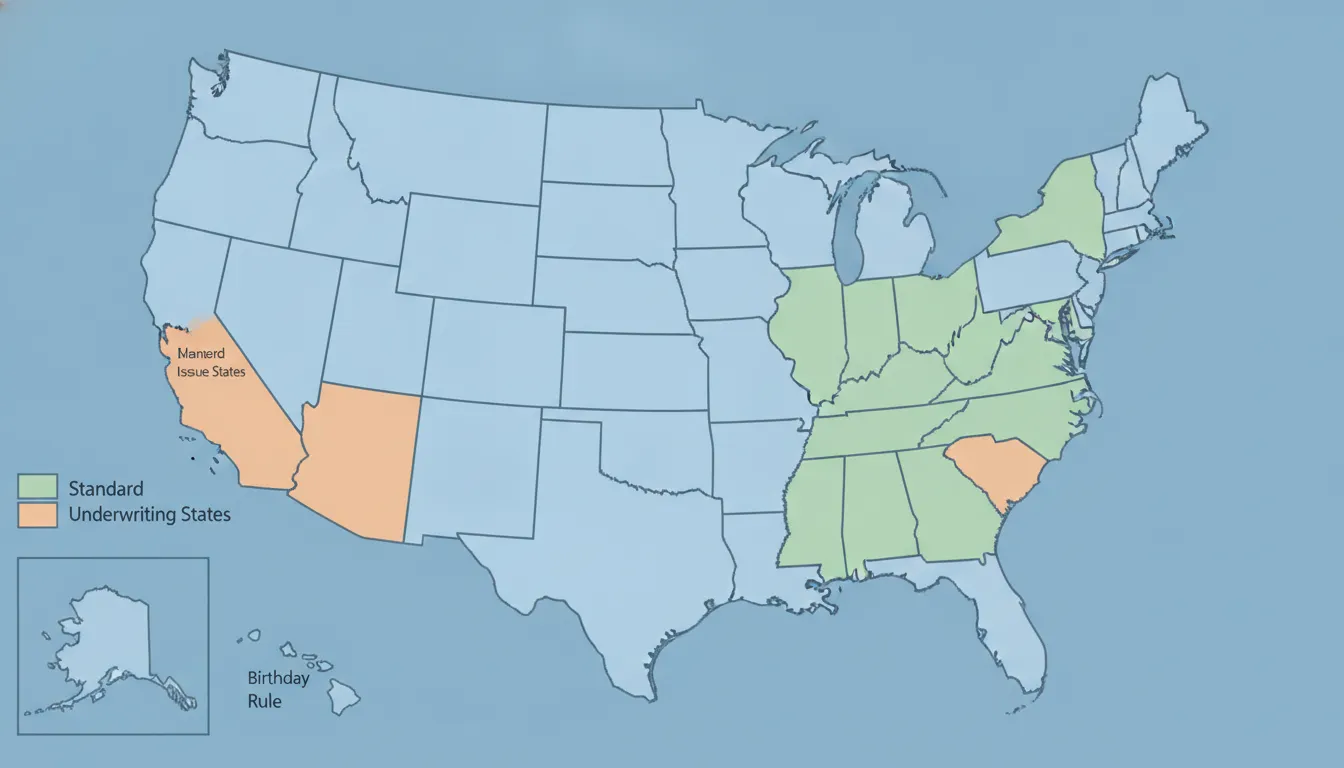
A handful of states offer guaranteed issue rights that make it easier to switch Medigap plans. These protections are especially valuable if you are moving to a state that provides them. In New York and Connecticut, you can switch Medigap plans at any time without answering health questions. California and Oregon have birthday rules that allow you to switch to an equal or lesser plan within a set period around your birthday. Washington state offers an anniversary rule tied to your plan start date. The table below summarizes these protections so you can see how your new state handles Medigap changes.
| State Protection Type | How It Works | Example States |
|---|---|---|
| Guaranteed Issue | Switch plans any time without health questions. | NY, CT, MA, ME |
| Birthday Rules | Switch plans near your birthday each year. | CA, OR |
| Anniversary Rule | Switch plans on your policy start date. | WA |
| Medical Underwriting | Answer health questions to switch plans. | Most other states |
Medicare Special Enrollment Period for Moving: Your Complete Timeline
A move-related Special Enrollment Period gives you up to three months total to change your Medicare Advantage or Part D plans. Notifying your plan before you move gives you the widest window: coverage starts the month before you leave and continues for two months after you arrive. Missing this window means returning to Original Medicare without drug coverage.
Moving to a new home is a significant life event, but your healthcare transition does not have to be stressful. When you relocate outside your current plan service area, you qualify for a Special Enrollment Period. This SEP allows you to switch Medicare Advantage or Part D plans without penalties. Understanding the timing of this window is essential to maintaining continuous coverage throughout your move.

Your window to act
The exact timing of your SEP depends on when you notify your plan about your move. If you tell your plan before you move. Your SEP starts the month before your move date and remains open for two full months after the month you move. This early notice helps you set up coverage that begins as soon as you arrive. If you notify your plan after moving, your SEP begins the month you contact them and continues for two additional months. Missing this window means you return to Original Medicare without drug coverage, so it is important to act promptly. You can find a local Medicare broker to help you track these critical deadlines and avoid gaps in coverage.
Step-by-step moving timeline
Following a structured plan keeps your Medicare coverage on track during your move. Use these steps to ensure every deadline is met.
- Notify your current plan before you move. Call your insurance company with your new address at least one month before your move date. This starts your SEP early so your new plan can take effect the day you arrive.
- Update your address with Social Security. Log into your my Social Security account or call 800-772-1213. Updating your address ensures Medicare sends your enrollment notices and plan information to your new home.
- Search for plans in your new ZIP code. Medicare plans and prices change from one county to the next. Use the Medicare Plan Finder to see which plans serve your new area and compare their costs and drug coverage.
- Select and enroll in your new coverage. Once you find the right plan, complete your enrollment before your SEP expires. If you are moving to a state like Florida, Texas, or Arizona, The Big 65 can help you compare plans at no cost.
- Verify your start date. Confirm with your new plan that coverage begins the first day of the month after enrollment. This prevents any gap between your old and new coverage.
If you move back to the United States
The rules are slightly different if you return to the U.S. after living abroad. In this case, you receive a two-month SEP that begins the month you return to the country. You can use this window to enroll in a Medicare Advantage or Part D plan that covers your new residence. Official Medicare.gov guidelines provide full details on returning residents enrollment rights.
State-Specific Rules for Medicare When Moving
Medigap pricing, guaranteed issue rights, and plan availability vary by state. New York, Connecticut, Maine, and Massachusetts offer year-round guaranteed issue. California and Oregon have birthday rules that allow annual plan switches without health questions. Most other states require medical underwriting to change Medigap plans after you move.
Medicare is a federal program, but certain rules and costs vary by state. Your Medigap pricing, guaranteed issue protections, and plan availability all depend on your new state of residence. Understanding these differences before you move helps you budget accurately and choose the best coverage for your situation.
Medigap pricing and medical underwriting
In most states, insurance companies can use medical underwriting when you apply for a new Medigap plan. This means they can review your health history and charge a higher premium or deny coverage based on pre-existing conditions. If you move and want to switch Medigap plans, you may have to answer health questions or provide medical records. Additionally, the same plan letter may cost more or less in different ZIP codes because insurance companies set rates based on local healthcare costs. As AARP notes, Medigap costs vary significantly by state and region.
States with strong beneficiary protections
Several states provide extra protections that make switching Medigap plans easier. New York, Connecticut, Maine, and Massachusetts offer year-round guaranteed issue rights, allowing you to purchase any Medigap plan without medical underwriting at any time. New York also uses community rating, meaning everyone in the same area pays the same premium regardless of age or health status. If you are considering moving to one of these states, you have more flexibility to change plans after you arrive. Review the published state rules to understand your options before locking in new coverage.
Birthday rules and anniversary rules
California and Oregon offer birthday rule protections that allow Medigap policyholders to switch to a plan with the same or lesser benefits once per year around their birthday. This switch does not require medical underwriting. Washington state offers a similar annual window tied to your plan anniversary date. These provisions give you the opportunity to find lower monthly rates without risking denial due to health conditions. If you move to a state with these protections, you gain valuable flexibility to adjust your coverage annually.
Keep your trusted broker
Moving does not mean you have to find a new insurance agent. The Big 65 is licensed in 33 states, including Florida, Texas, New York, California, and Arizona. This means you can often keep the same dedicated broker even after relocating. We can help you check Special Enrollment Period rules, compare plans in your new state, and ensure your coverage transitions smoothly. Contact The Big 65 before your move to create a personalized Medicare transition plan.
Frequently Asked Questions
Do I need to notify Medicare when I move to a new state?
Yes, you must update your address with the Social Security Administration. You can do this by logging into your my Social Security account or by calling 800-772-1213. Updating your records ensures your Medicare bills and plan notices reach you at your new home. While Original Medicare works across the country. The government needs your current ZIP code to determine which plans are available in your area and to handle your premium payments correctly.
How long do I have to change my Medicare plan after moving?
Most moves trigger a Special Enrollment Period that lasts for two full months after the month you move. If you notify your plan before you move, your window begins one month before your move date. According to CMS.gov, this period allows you to switch to a new Medicare Advantage or Part D plan in your new service area. If you miss this window, you may have to wait for the annual Open Enrollment Period to make changes to your coverage.
Can I keep my current Medigap policy if I move out of state?
Yes, Medigap plans are standardized across the country, so your policy usually follows you when you move to a new state. However, your monthly premium may change based on healthcare costs in your new ZIP code. According to AARP, you should notify your insurance company of your new address to ensure bills reach you. If you move to Massachusetts, Minnesota, or Wisconsin, your plan options may differ because these states use their own Medigap standardization systems.
Can I switch from Medicare Advantage to Original Medicare when I move?
Yes, moving outside your plan service area gives you the right to disenroll from Medicare Advantage and return to Original Medicare. During your move-related SEP, you can leave your Advantage plan and enroll in a standalone Part D plan for prescription coverage. This is also an opportunity to purchase a Medigap plan, though you may be subject to medical underwriting in most states. If you move to one of the guaranteed issue states, you can enroll in a Medigap plan without health questions.
What happens to my Medicare coverage if I move within the same state?
If you move within the same state but to a different county, your Medicare Advantage or Part D plan may end if you leave the plan service area. You should call your plan provider to confirm whether your new address is still covered. Original Medicare and Medigap plans are generally unaffected by intrastate moves. Always update your address with both Social Security and your private plan to continue receiving important documents.
Reach out to The Big 65 for a free Medicare transition consultation. Our licensed brokers help seniors in 33 states find the right coverage before, during, and after a move. We review your current plans, explain your new state options, and ensure you never experience a gap in your healthcare coverage.
We do not offer every plan available in your area. Currently, we represent 10 organizations that offer 50 products in your area. Please contact Medicare.gov or 1-800-MEDICARE to get information on all of your options.
Not Sure Which Medicare Plan Is Right for You?
Medicare is complicated, but you do not have to figure it out alone. With over 20 years of experience, Karl Bruns-Kyler can help you compare plans, avoid costly mistakes, and find the coverage that fits your needs and budget.
Call (877) 850-0211
Or schedule a free consultation at a time that works for you.
There is never a charge for my services. Your premium is the same whether you work with me or go direct.
Disclaimer: We do not offer every plan available in your area. Currently, we represent 10 organizations that offer 50 products in your area. Please contact Medicare.gov or 1-800-MEDICARE to get information on all of your options.